Ever wondered whether WhatsApp marketing actually works, or if it’s just hype?
Sure, the platform boasts a monthly active user base of over 3 billion users and open rates of over 90%, but what does that look like in action?
That’s exactly what this blog will explore.
Below, I’ve put together 10 WhatsApp marketing campaign examples from brands across industries to demonstrate what you can achieve with the platform (and hopefully spark a few ideas for your own campaigns).
So, let’s get right into it.
Top 10 WhatsApp Marketing Campaign Examples and Case Studies
The examples in this list span a wide range of industries, including e-commerce and retail, aviation, food and beverage, and entertainment. They also cover a variety of use cases, from lead generation and promotions to customer engagement and support.
Here’s a closer look at them.
1. Knorr
Knorr is a global food brand that offers a wide range of cooking essentials, including soups, stocks, seasonings, and sauces.
The Objective
Knorr Mexico sought to attract the attention of a younger audience by creating a more engaging and interactive brand experience on WhatsApp.
The Campaign:
The brand partnered with reggaeton artist El Malilla and ran a click-to-WhatsApp ad campaign targeting younger audiences in Mexico City.
Once users clicked on these ads, they entered an AI-powered WhatsApp experience where they could receive personalized voice messages from El Malilla, generate images with him, and get recipe suggestions featuring Knorr products.
To make the experience more interactive, Knorr used WhatsApp Flows to guide users through different steps, from selecting features and sharing inputs to receiving personalized responses in the chat. The brand also sent follow-up messages to encourage users who had only tried one feature to come back and explore other options.
The Results:
Nearly half a million people (429,854) engaged with Knorr Mexico’s click-to-WhatsApp ad campaign, and audience members sent close to two million spontaneous messages (1,978,615).
A Meta brand lift test also revealed clear improvements across key metrics:
- 35.1-point lift in ad recall
- 33.6-point lift in brand awareness
- 3.5-point lift in purchase intent

2. Air France
Air France is France’s largest airline, with flights to nearly 200 destinations around the world. It also handles a high volume of digital bookings, selling an estimated one ticket every five seconds through its digital platforms.
The Objective:
Air France wanted to keep up with modern traveler expectations by delivering timely updates and support throughout the travel journey on WhatsApp.
The Campaign:
Air France promoted its WhatsApp channel across its digital touchpoints, including its website, emails, and social media accounts. It also used click-to-WhatsApp ads to promote its travel offers newsletter and drive user opt-ins.
Once customers opted in to receive communications, the airline sent them promotional messages featuring travel deals and destination offers, along with personalized upgrade offers for seats, meals, and luggage after booking.
It also sent boarding passes, check-in reminders, and other time-sensitive flight updates on the messaging app. For customer support, Air France handled queries about trips, luggage, and miles through a mix of WhatsApp automation and live agents when needed.
Finally, the airline also used WhatsApp to send one-time passwords (OTPs) to verify customer identity for account access and opt-in confirmation.
The Results:
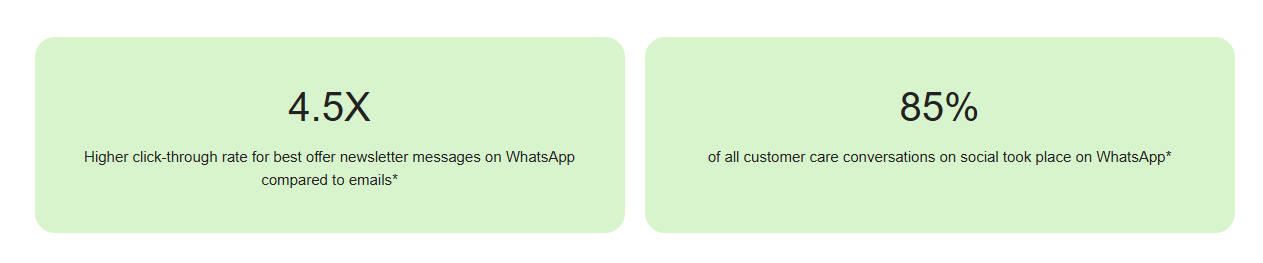
Air France exchanged more than 33 million messages with its customers on WhatsApp between April 2024 and April 2025 and reported 4.5X higher click-through rates for its newsletter compared to email.
It also found that 85% of all its customer care conversations took place on WhatsApp.
3. Nivea
Nivea is a German skincare brand owned by Beiersdorf AG, a Hamburg-based company founded in 1882. The company also owns brands like Eucerin and Aquaphor and operates in more than 200 countries worldwide.
The Objective:
Nivea Mexico wanted to attract new customers and increase engagement by offering personalized skincare consultations on WhatsApp.
The Campaign:
Nivea launched an automated WhatsApp experience called the “Skincare Routine Advisor,” powered by WhatsApp Flows.
To drive users into the experience, the brand ran click-to-WhatsApp ads featuring short videos. Once users clicked on them, they were guided through a series of automated questions on WhatsApp to assess their skin type and concerns. Based on their responses, the experience generated personalized product recommendations.
At the end of the experience, users could purchase these products from an e-commerce platform.
The Results:
Nivea used a Meta brand lift study to measure the performance of this campaign and reported:
- An 8.4-point lift in ad recall
- An 86% messaging experience completion rate
- A 21% conversation initiation rate
- 25,681 qualified potential customers

4. LuLu Hypermarket
LuLu Hypermarket is a retail chain operating across the UAE, Saudi Arabia, Egypt, India, and Indonesia. It’s known for its large-format stores that combine grocery shopping with added conveniences like food courts and play areas.
The Objective:
LuLu Hypermarket wanted to upgrade its marketing and customer service experience by implementing a variety of WhatsApp Business Platform solutions.
The Campaign:
LuLu Hypermarket enabled real-time grocery ordering on WhatsApp and used transactional messages to confirm deliveries and give customers the option to reschedule delivery times when needed.
The chain also made it easy for customers to access the latest offers and check loyalty points and previous receipts by clicking links sent in messages or by accessing LuLu’s WhatsApp channel.
Finally, LuLu also used WhatsApp to retarget customers, automate real-time support, and register users for events like its annual Hypermarket Walkathon.
The Results:
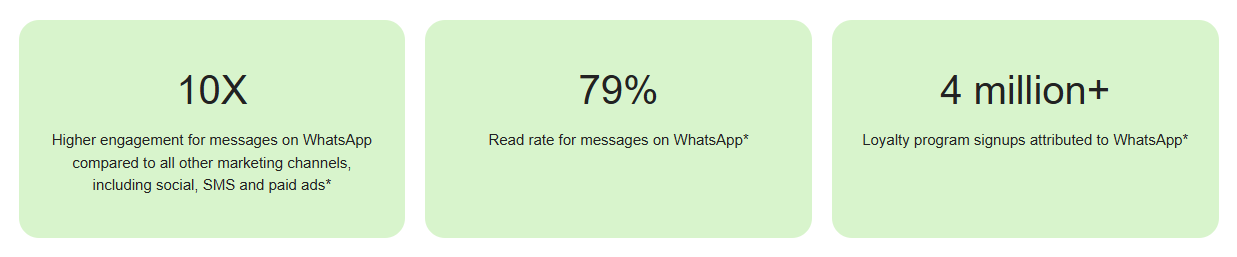
In the first 15 months of using the WhatsApp Business Platform, LuLu Hypermarket reported a sharp increase in engagement. It also saved millions of dollars by eliminating the need for printing marketing circulars. Here’s a look at its results:
- 10× higher engagement compared to other channels
- 79% read rate for WhatsApp messages
- Over 4 million loyalty program signups attributed to WhatsApp
5. Tata CLiQ

Tata CLiQ is the flagship e-commerce platform of the Tata Group, offering a wide range of products across electronics, home, fashion, and beauty.
The Objective:
Tata CLiQ wanted to boost customer engagement by reaching opted-in users through a more personalized, dynamic channel than email or SMS.
The Campaign:
The brand initially used WhatsApp for transactional updates, such as order confirmations and shipping notifications. It then expanded its use to include targeted marketing campaigns during high-traffic periods like Diwali and Black Friday.
Tata CLiQ also used data-driven insights to target a percentage of customers with personalized messages based on their behavior on the platform. These messages included product recommendations based on recent browsing history, abandoned-cart reminders, price-drop alerts for wish-listed products, and welcome offers for new users.
The Results:
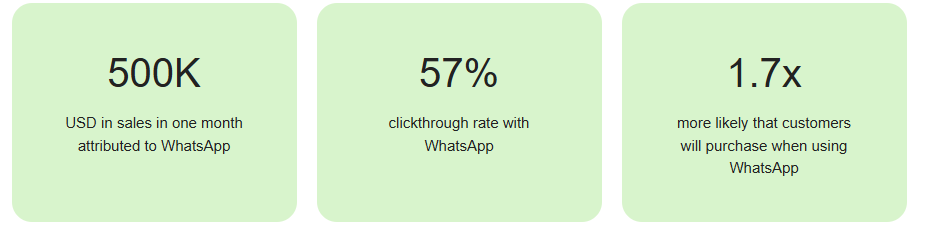
Tata CLiQ reported a 10X increase in ROI and saw significant improvements in customer engagement and sales. Here’s a look at their results:
- $500,000 in sales attributed to WhatsApp in one month
- 57% click-through rate on WhatsApp messages
- Customers were 1.7× more likely to make a purchase via WhatsApp
Send promotional broadcasts, automate customer journeys, and drive repeat purchases on WhatsApp with WANotifier.
6. Domino’s Pizza
Domino’s Pizza is a global fast-food chain known for its pizza delivery and takeaway services, operating in over 90 countries with more than 14,900 stores.
The Objective:
The brand’s Indonesian arm was looking for new ways to boost engagement on its app, increase order values, and turn new customers into loyal patrons.
The Campaign:
Domino’s Pizza Indonesia shifted a significant portion of its marketing efforts from email and push notifications to WhatsApp.
As part of this shift, the brand began sending daily WhatsApp messages to customers who typically ordered in-store, encouraging them to switch to the app. It also sent personalized messages to new customers every two weeks to convert them into regulars.
Domino’s Indonesia also introduced a “scan and win” loyalty program, in which customers could scan QR codes on pizza boxes that directed them to WhatsApp to upload their receipts and verify their purchases. Once verified, they would get cash vouchers for their next in-app purchase, and receive ongoing promotional messages and incentives to keep them engaged
The Results:
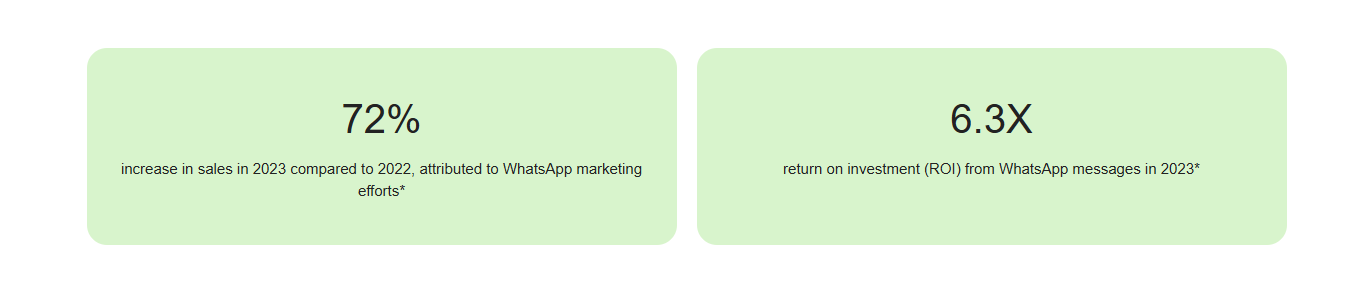
After implementing its WhatsApp strategy, Domino’s Indonesia saw clear gains in sales and customer engagement:
- 72% increase in sales
- 6.3X return on investment (ROI) from WhatsApp messages
- Around 3,000 customers engaged on WhatsApp each week
7. Benefit Cosmetics

Benefit Cosmetics is a global beauty brand known for its high-end cosmetics and a range of brow and waxing services, operating in over 59 countries.
The Objective:
The global cosmetics brand wanted to deliver faster and more convenient customer service by enabling self-service options for appointment scheduling and support queries.
The Campaign:
Benefit Cosmetics introduced a self-service experience on WhatsApp, allowing customers to book brow or lip wax appointments directly in the chat and receive confirmations and reminders. It also used WhatsApp chatbots to help customers:
- Modify appointments
- Check loyalty reward points
- And get answers to FAQs (about common topics like store hours)
To drive adoption, Benefit added a direct entry point to WhatsApp on its website and used click-to-WhatsApp ads to encourage customers to subscribe to its marketing messages.
The Results:
Benefit Cosmetics improved both its service efficiency and overall customer experience by integrating WhatsApp as a communication channel. Here’s a look at its key results:
- 30% increase in brow and lip wax bookings
- 200% year-over-year growth in sales (partially attributed to WhatsApp)
- 60% faster agent response times vs email
- Improved productivity as more customers used WhatsApp chatbots

8. Yves Rocher

Yves Rocher is a French skincare and beauty brand that sells its products both online and in stores worldwide. In locations like Hong Kong, it also offers in-store beauty treatments.
The Objective:
The brand’s Hong Kong location was looking to boost its appointment bookings through an automated solution.
The Campaign:
Yves Rocher launched an automated WhatsApp assistant to streamline appointment scheduling and consultations.
Customers could trigger it by messaging Yves Rocher on WhatsApp to learn about its skincare solutions. The assistant then guided them through different treatment options while collecting details such as their preferred store and desired service. Based on this information, a beauty advisor followed up to complete the consultation and finalize the booking.
Customers also received booking confirmations at the end of the conversation and automated reminders close to the appointment. They could also contact their preferred store directly at any point within the same chat.
The Results:
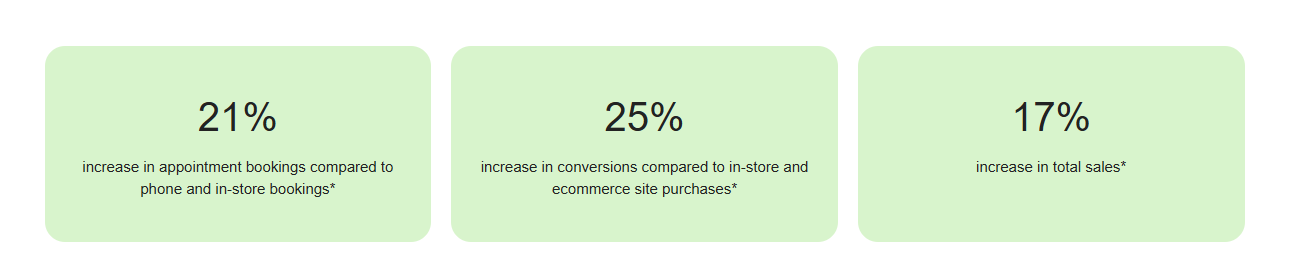
Yves Rocher tracked the performance of its automated experience over a three-month period and reported:
- A 21% increase in appointment bookings
- A 25% increase in conversions
- And, a 17% increase in total sales
9. Shark Tank

Shark Tank is a popular television show where entrepreneurs pitch their business ideas to a panel of investors in hopes of securing funding.
The Objective:
Sony Channel Mexico wanted to use WhatsApp to attract new subscribers and send them promotions, offers, and updates related to Shark Tank Mexico.
The Campaign:
Sony Mexico ran click-to-WhatsApp ads to promote Shark Tank Mexico’s WhatsApp channel and attract new subscribers.
Once users clicked on these ads, they were directed to an automated WhatsApp flow where they could opt in to receive announcements, offers, discounts, and updates about the show.
After opting in, users could also engage with a variety of content on Shark Tank’s WhatsApp channel, including personalized pitch recommendations, featured pitches from other entrepreneurs, and exclusive content such as themed sticker packs that could be accessed via QR codes.
The Results:
According to Sony Channel Mexico, this approach helped grow its WhatsApp subscriber base while maintaining audience engagement throughout the TV season.
10. Clarins

Founded in 1954, Clarins is a French premium cosmetics brand known for its skincare solutions, makeup, and fragrances.
The Objective:
Clarins was looking to connect with its customers and drive engagement by running a campaign around National Lipstick Day.
The Campaign:
The beauty brand launched a WhatsApp campaign targeting customers who had previously opted in to receive messages.
The campaign used personalized messages to engage users, prompting them to choose their preferred lipstick type (intense color, glossy, or lip-plumping). Based on their selection, they were shown a relevant video and then redirected to the Clarins website for personalized advice to help them find the right product or shade.
The Results:
Clarins ran the campaign in the lead-up to National Lipstick Day and compared its performance against a similar email campaign.
The WhatsApp campaign outperformed email, delivering:
- A 90% open rate
- 4.5X higher open rate than email
- 7X higher conversion rate than email

Want to Launch Your Own WhatsApp Marketing Campaign?
You’ve now seen how businesses are using WhatsApp to automate engagement, build stronger customer relationships, and drive conversions.
If you’re looking to achieve similar results, the first step is getting access to the WhatsApp Business API: a programmatic solution by Meta that lets you send and receive messages at scale, automate workflows, and integrate WhatsApp with other tools.
However, there’s one important thing to keep in mind: the API doesn’t come with a built-in dashboard or interface for direct use. To actually run campaigns with it and use its features, you need a third-party platform.
Now, there are many WhatsApp marketing platforms that come with pre-built tools to leverage the API’s capabilities. However, most of them charge a 12% to 25% markup on WhatsApp’s messaging costs (which can significantly drive up your campaign costs).
This is where WANotifier stands out.
An official Meta Tech Partner, WANotifier is an all-in-one WhatsApp marketing and automation platform that lets you do everything you’ve seen in the examples above, from running click-to-WhatsApp ad campaigns and sending promotional messages at scale to automating workflows with chatbots and auto replies.
It also lets you integrate WhatsApp with your website, forms, and other third-party apps, and monitor campaign performance and ROI using advanced analytics.
The best part is that WANotifier charges 0% markup on WhatsApp’s API usage costs and offers transparent pricing that scales with your business.
Apart from this, it provides flexible setup options (use the embedded signup flow or your own API credentials), best-in-class customer support, and a 7-day free trial on all paid plans.
Elevate your WhatsApp marketing with WANotifier. Easy to set up. Built to scale. No hidden costs.
Frequently Asked Questions (FAQs)
What is a WhatsApp marketing campaign?
A WhatsApp marketing campaign is an outreach strategy where businesses use WhatsApp to send messages, updates, or alerts to opted-in contacts to either promote something or drive a specific action, such as:
- Completing a purchase
- Signing up for a service
- Booking a demo or appointment
- Filling out a form or survey
… and more.
What types of campaigns can you run on WhatsApp?
Businesses can run a variety of campaigns on WhatsApp, including:
- Promotional campaigns (discounts, offers, product launches)
- Lead nurturing campaigns (using one-time messages or drip campaigns)
- Loyalty programs and re-engagement campaigns (for abandoned cart reminders, inactive customers, and more)
- Post-purchase Campaigns (for reorder reminders, cross-selling, and reviews and feedback requests)
How much do WhatsApp marketing campaigns cost?
The cost of a WhatsApp marketing campaign depends on two things:
- The platform you use to access the WhatsApp Business API
- And WhatsApp’s messaging charges
Most platforms charge a subscription fee (monthly, quarterly, or annually) for access to tools that help you run campaigns, automate workflows, and manage conversations.
In addition to this, you must also account for WhatsApp’s per-message pricing model, where businesses are charged for each delivered message template. Note that the charges vary based on the type of message you’re sending (marketing, utility, or authentication) and the recipient’s location.
It’s also worth noting that some platforms add a 12% to 25% markup on these messaging charges, which can significantly increase your overall costs. That’s why choosing a platform that offers 0% markup, like WANotifier, can make a noticeable difference to your marketing expenses.
What industries can benefit most from WhatsApp marketing campaigns?
WhatsApp marketing works well across a wide range of industries, especially those that rely on timely and personalized communication with customers, such as:
- E-commerce and retail
- Travel and hospitality
- Food and beverage
- Education
- Healthcare